Hybrid Quantum Sim
A Physical Review X paper published October 7, 2026 proposes pairing superconducting…
Full description
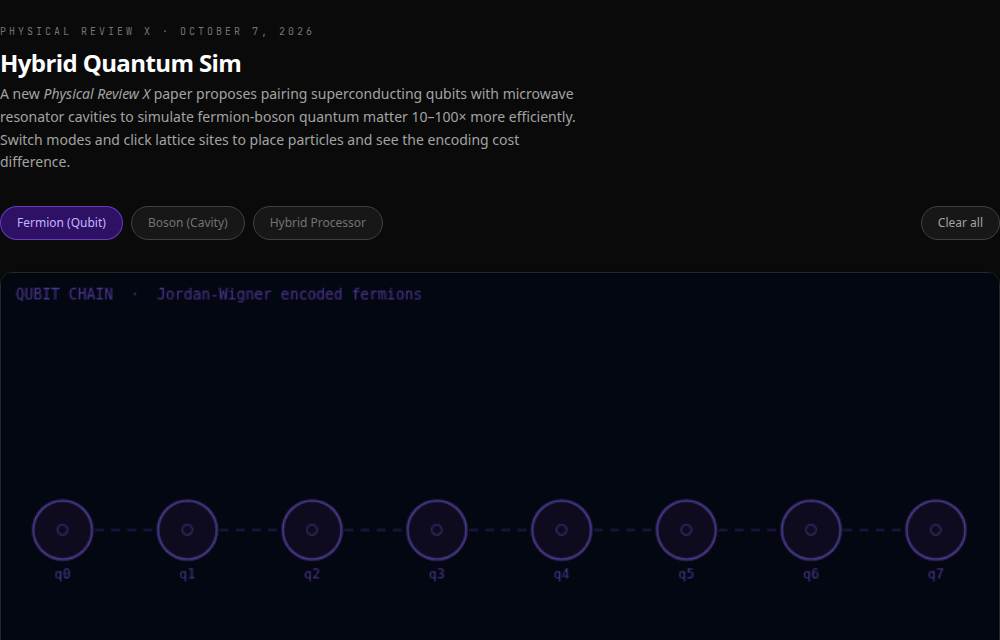
A Physical Review X paper published October 7, 2026 proposes pairing superconducting qubits with microwave resonator cavities in a hybrid processor that can simulate fermion-boson quantum field theories — Hubbard-Holstein models, (2+1)D lattice gauge QED, polaronic systems — 10–100× more efficiently than qubit-only approaches; encoding fermions on qubits requires Jordan-Wigner strings (one Pauli-Z gate per site per hop, growing linearly), while bosons map naturally onto cavity Fock states |0⟩,|1⟩,|2⟩… with no overhead, and the Jaynes-Cummings interaction g couples each qubit-cavity pair so that fermion-boson interaction terms cost O(1) gates instead of O(N); the paper's error model shows hybrid hardware at 10⁻³ gate error matches qubit-only hardware at 10⁻⁶ for equivalent simulation quality — a 1000× relaxation making near-term quantum advantage viable; switch between Fermion (qubit chain with glowing Jordan-Wigner Z-strings between occupied sites), Boson (cavity array where clicking a site stacks photons in Fock states |1⟩–|4⟩), and Hybrid (4 qubit-cavity column pairs with animated Jaynes-Cummings coupling arrows) modes, click lattice sites to place particles or add photons, watch the JW gate cost counter vs. hybrid gate cost drop by ~80×, read a mode-sensitive explainer, browse eight fact cards covering Jordan-Wigner strings, bosonic Fock states, Pauli exclusion, bosonic bunching, the Jaynes-Cummings interaction, error budget relaxation, what models the hybrid approach can target, and the PRX paper itself, and trace the full fermions → JW transform → qubit register + bosons → oscillator encoding → cavity → hybrid processor → lattice simulation pipeline in a Mermaid flowchart.